Filling G5, G6, G7
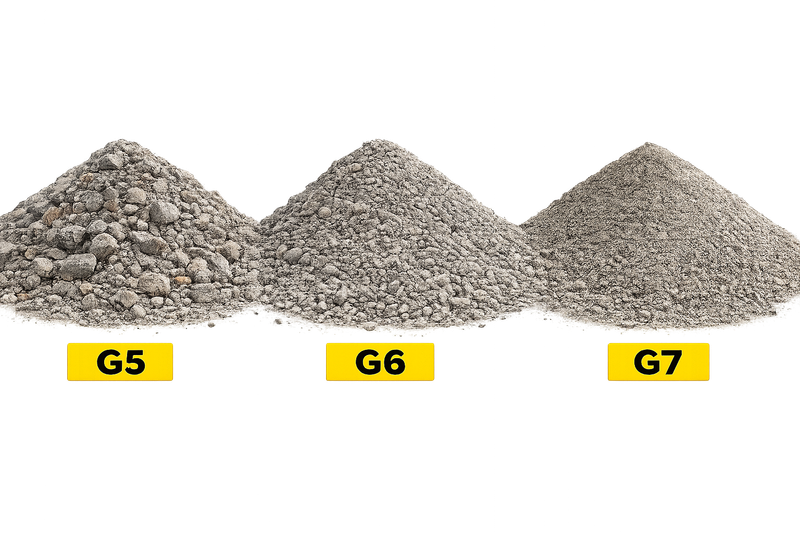
In South Africa, G5, G6, and G7 refer to graded filling materials used for earthworks and foundations, not to the brickwork itself. They are classified according to the quality and engineering properties of the material under the COLTO/COTO grading system.
| Material | Description | Typical Use | Compaction Quality |
|---|---|---|---|
| G5 | High-quality crushed gravel with well-graded fines | Foundations, floor slabs, roads, paving, structural fill | Excellent |
| G6 | Natural gravel or crushed material of slightly lower quality than G5 | General filling, sub-base, under paving and slabs | Good |
| G7 | Lower-grade gravel/soil mixture | Bulk filling, backfilling, building platforms, light-duty foundations | Moderate |
G5 Filling
- Highest quality of the three.
- Compacts extremely well.
- Used beneath:
- Concrete floor slabs
- Strip foundations
- Driveways
- Industrial floors
- Preferred where heavy structural loads are expected.
G6 Filling
- Good-quality natural gravel.
- Suitable for:
- House platforms
- General filling
- Base under paving
- Areas carrying moderate loads
- Less expensive than G5 while still providing good compaction.
G7 Filling
- Lower-quality gravel-soil mix.
- Typically used for:
- Bulk filling
- Raising site levels
- Backfilling trenches
- Sub-base beneath better-quality layers
- Usually covered with G5 or G6 before placing concrete or paving.
Which should you use?
- Under a house foundation: G5 is generally recommended.
- Under a residential floor slab: G5 (sometimes G6 if approved by the engineer).
- General site filling: G6.
- Large-volume filling where the material will later be capped with higher-quality fill: G7.
Typical Layer Build-Up for a House
- Natural ground
- Compacted G7 (if significant filling is needed)
- Compacted G5 (100–150 mm)
- Damp-proof membrane (DPM)
- Reinforcement (if required)
- Concrete slab
- Brickwork constructed on the foundation
This approach provides a stable, well-compacted base while using materials cost-effectively. Engineers often specify G5 as the final bearing layer because it offers better load-bearing capacity and compaction than G6 or G7.
Read More